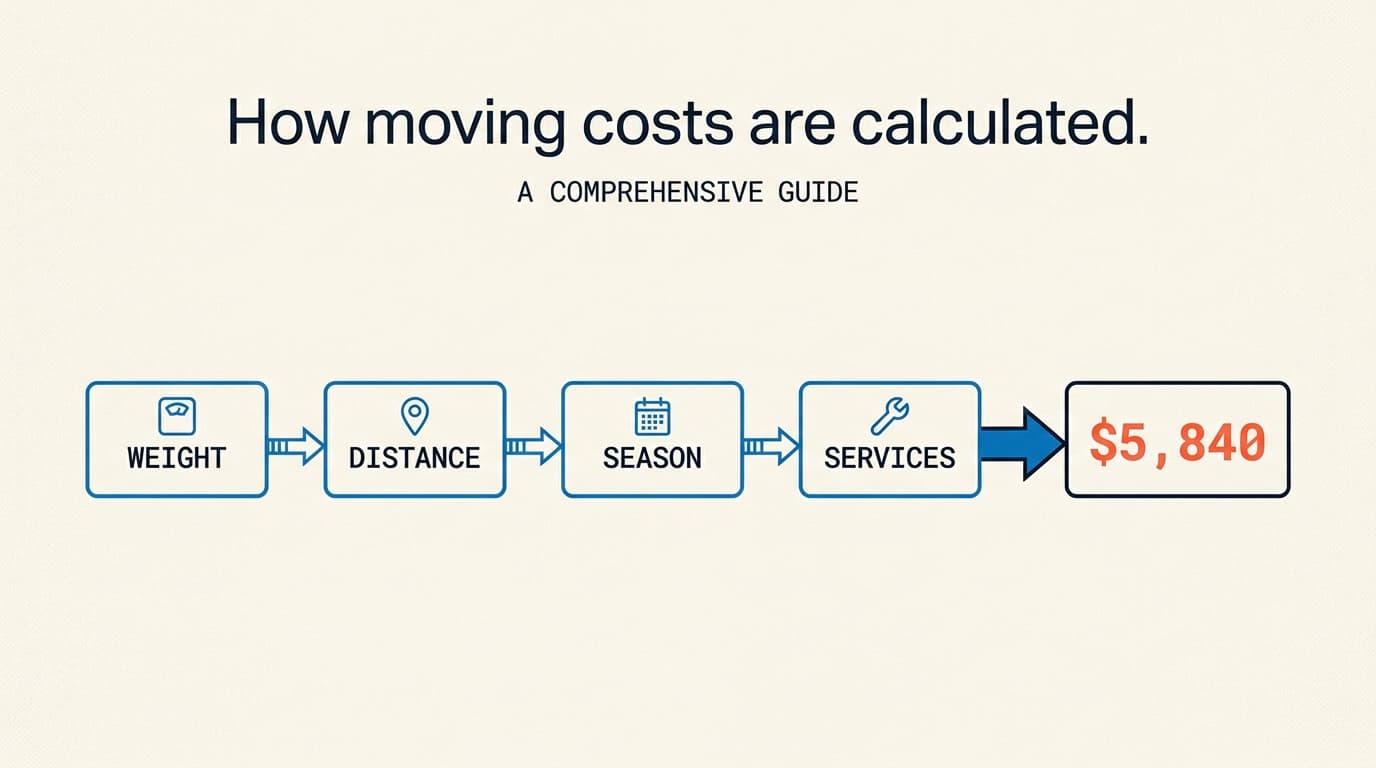
Long-distance moving costs are calculated by four factors: weight (estimated from home size), distance (the route), seasonality (which month you move), and add-on services (packing, storage, specialty items, insurance). Multiply them together and you have your estimate. Local moves use a different formula — hourly labor — but the same logic applies.
The formula
For long-distance and interstate moves (anything over ~50 miles), the math is:
estimate = weight (lb)
         × (distance / 1,000 mi)
         × corridor rate per 1,000 lb per 1,000 mi
         × seasonality multiplier
         × service multiplier
Each factor is independent — change one and the estimate moves predictably. That's why our calculator can show you the math line by line: every input has a clear contribution to the total.
1. Weight
Movers don't weigh your stuff before quoting — they estimate weight from home size, using AMSA industry standards. The defaults we use:
| Home size | Estimated weight |
|---|---|
| Studio | 1,800 lbs |
| 1 bedroom | 2,500 lbs |
| 2 bedrooms | 5,000 lbs |
| 3 bedrooms | 7,500 lbs |
| 4 bedrooms | 10,000 lbs |
| 5+ bedrooms | 15,000 lbs |
Rough rule: each bedroom adds about 2,500 lbs. Heavy items (treadmill, gun safe, piano) push you up a tier. Sparse furnishings push you down.
2. Distance
Long-distance pricing is based on the actual driving route — not straight-line distance. Most movers use Google or PC*Miler-style routing software. The national baseline rate is about $0.70 per pound per 1,000 miles, with regional adjustments for specific corridors (high-volume routes like CA→TX cost less per mile than rare ones like ND→VT).
Worked example: a 2-bedroom (5,000 lb) move over 1,500 miles at the baseline rate is 5,000 × 1.5 × 0.70 = $5,250 before season and services.
3. Seasonality
About 60–70% of US household moves happen between mid-May and end of August. Movers raise rates in peak months because demand exceeds truck capacity; winter months see steep discounts to fill schedules. The seasonality multipliers we use:
| Month | Multiplier | Notes |
|---|---|---|
| January | × 1.00 | Off-peak |
| February | × 1.00 | Off-peak |
| March | × 1.05 | Shoulder |
| April | × 1.10 | Shoulder |
| May | × 1.15 | Start of peak |
| June | × 1.22 | Peak |
| July | × 1.22 | Peak |
| August | × 1.18 | Tail of peak |
| September | × 1.10 | Shoulder |
| October | × 1.05 | Shoulder |
| November | × 1.00 | Off-peak |
| December | × 1.00 | Off-peak |
Within a month, the first and last weeks (lease turnover days) are 10–15% more expensive than mid-month. Weekends are similarly more expensive than weekdays.
4. Add-on services
Each add-on multiplies the base estimate. The typical multipliers:
- • Full packing — ~× 1.18. Movers pack every box for you.
- • Unpacking — ~× 1.06. Set up at the destination.
- • Storage in transit — ~× 1.10. 30 days of storage between origin and destination.
- • Specialty items — ~× 1.08. Piano, safe, art, gym equipment, etc.
- • Full-value protection — ~× 1.04. Replacement coverage instead of the federal $0.60/lb minimum.
Multipliers stack. Three add-ons of ~1.10 each compounds to ~× 1.33, not × 1.30.
Local moves are different
For moves under ~50 miles, weight × distance is irrelevant. Local moves are priced by labor: crew × hours × hourly rate plus a flat truck/fuel fee. National averages run $90–$150 per mover per hour; a typical 2-bedroom local move uses 2 movers for 4–6 hours, adding up to $720–$1,800 all in.
The confidence band
Real moving quotes vary route to route and mover to mover. Two reputable movers can quote 20% apart for the same load — different efficiency, different fixed costs, different demand pressure. We show our estimate as a range (typically 85% to 120% around the mid-point) so you know what falls within reason. Numbers far outside this band — especially below 85% — are worth a second look. Lowball quotes are the #1 mover-scam pattern.
Try the calculator
Enter your origin, destination, and home size below and watch each line of the formula populate. If you spot something off in a mover's quote, you'll know which line to challenge.