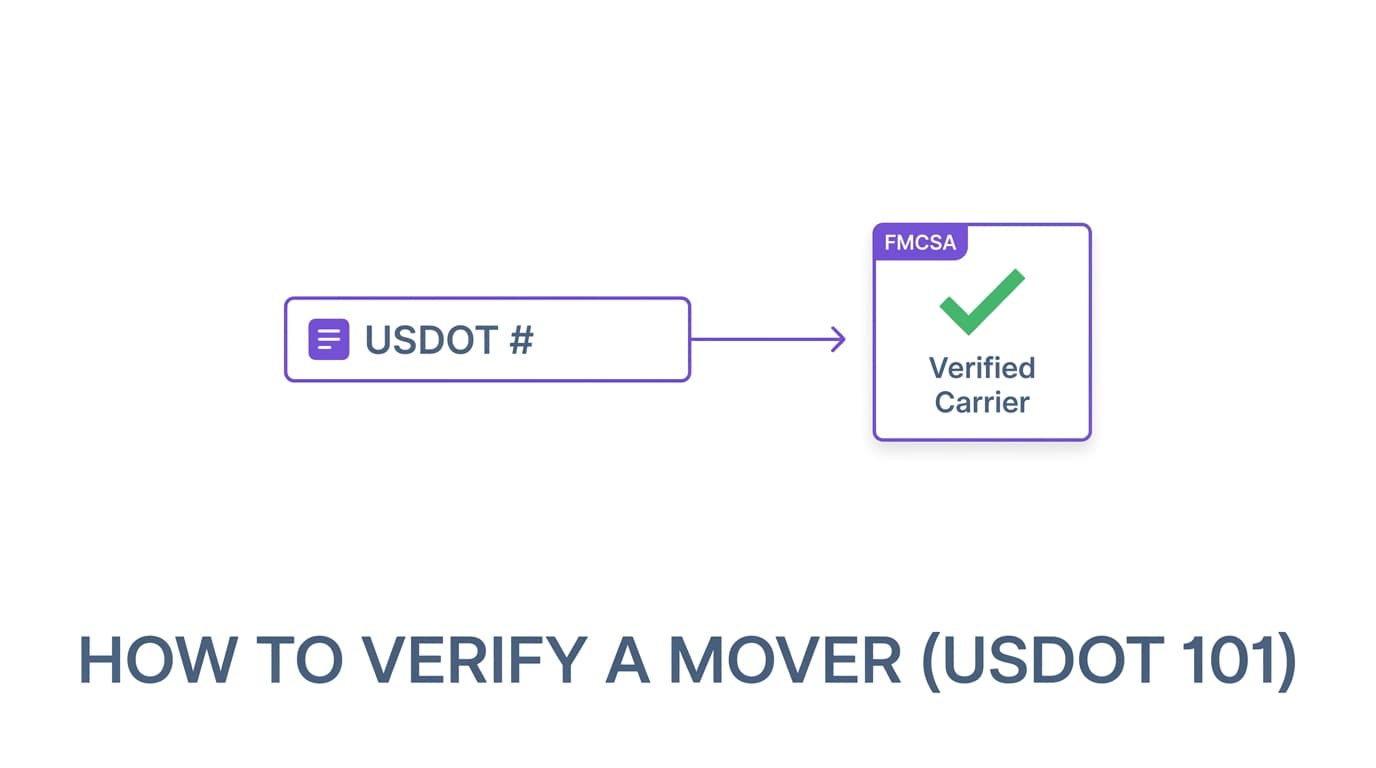
To verify any interstate mover in the US, look up its USDOT number in the FMCSA SAFER company snapshot tool. You're looking for: an active operating status, a current Motor Carrier (MC) number, a 25-year-or-older or convincingly documented operating history, and zero out-of-service orders. If any of these are missing, walk away.
USDOT and MC numbers, plainly
A USDOT number is the federal identifier the Department of Transportation issues to every commercial motor carrier operating in interstate commerce. A Motor Carrier (MC) numberis a separate FMCSA-issued operating-authority license that says the carrier is approved to transport household goods for hire across state lines. Most legitimate household-goods movers have both. Movers operating only within a single state may have neither — they're regulated by state agencies instead (typically the public utility commission).
Both numbers are public. A reputable mover lists them on its website, on every estimate, and on the side of every truck. If you can't find either on a quote you've received for an interstate move, that alone is enough to disqualify them.
The 90-second check
- 1. Open SAFER. safer.fmcsa.dot.gov/CompanySnapshot.aspx
- 2. Search by USDOT number (preferred) or company name. The mover's estimate should give you the USDOT — if not, ask.
- 3. Read four lines in the response, in order:
- Operating Status should say AUTHORIZED FOR HHG (Household Goods)
- Operation Classification should include Auth. for Hire
- Out of Service Date should be blank
- MCS-150 Form Date should be within the last 24 months
- 4. Cross-check the address. The HQ address listed on SAFER should match the address on the mover's estimate, website, and the side of any truck that shows up. Mismatched addresses are a top-five scam signal.
Four red flags from the SAFER snapshot
- Operating status "NOT AUTHORIZED". They cannot legally transport household goods across state lines. Don't book, regardless of price.
- Out-of-service order in effect. FMCSA pulled the mover off the road. They are operating illegally if they still book — and you'll have no insurance recourse.
- USDOT number registered less than 12 months ago with a freshly-named company. Scam operators rotate names and addresses quickly to escape complaints. A long history isn't a guarantee, but a brand-new entity quoting an unusually low long-distance price is the single most common scam pattern.
- MCS-150 Form date > 24 months old. FMCSA requires every active carrier to update its registration every 24 months. A stale MCS-150 means the carrier is no longer in compliance.
What movers must give you in writing
Federal regulation 49 CFR Part 375 obligates interstate movers to provide you four documents before any work begins: a copy of Your Rights and Responsibilities When You Move, a written binding or non-binding estimate, an order for service, and a bill of lading. If any of these is missing — especially the written estimate — refuse to load the truck. Once your goods are on the truck, your leverage drops to near zero.
Bonds and insurance
Interstate household-goods movers must hold cargo insurance and a surety bond. The default federal liability for damaged goods is $0.60 per pound per item— that's a $30 maximum payout on a 50 lb TV. If you have valuable items, ask explicitly for Full Value Protection, which costs ~4% of the move and replaces or repairs damaged items at full value. Get the coverage type and dollar limits in writing on the bill of lading before the truck leaves.
When something goes wrong
File a complaint with FMCSA at nccdb.fmcsa.dot.gov — the National Consumer Complaint Database. FMCSA does take action, including revoking authority, but the process is slow and not designed for emergency situations. For an active hostage shipment (mover refusing to deliver pending payment of charges not in your estimate), call FMCSA directly at 1-888-368-7238 and your state's attorney general office.
Bottom line
Spend 90 seconds on the SAFER snapshot before signing any estimate. That single check eliminates the overwhelming majority of moving-industry fraud. The fancy uniform, the truck wrap, the friendly sales call — none of those are evidence. The USDOT number is.